
Your client's cloud account has a familiar shape. A posture scanner reports an exposed storage resource and an over-permissive IAM policy. A second tool lists roles, network paths, and reachable services. Neither result proves that the policy can be abused or that sensitive data is actually reachable. That distinction matters when an MSSP has to defend a finding in front of a client.
A scanner that flags a risky IAM policy and a tool that proves the policy can be abused aren't interchangeable. This list sorts ten cloud computing testing tools by the job they do in a penetration-testing engagement: read-only posture audit, attacker-view enumeration, or live attack validation. It also flags what each tool misses, where scoping can fail, and how well each product fits repeatable MSSP delivery.
Cloud testing has to account for more than individual servers. NIST's cloud definition established five essential characteristics, three service models, and four deployment models. That means a serious test must consider identities, APIs, orchestration, tenant boundaries, dynamic allocation, and ephemeral assets.
For teams building infrastructure-as-code controls, the DevArmor guide to IaC security is a useful companion to the operational testing workflow below.
Table of Contents
- 1. Wiz Cloud and AI Security Platform CNAPP
- 2. Orca Security Agentless CNAPP
- 3. Palo Alto Networks Prisma Cloud CNAPP
- 4. Prowler Open Source and Prowler Cloud SaaS
- 5. NCC Group ScoutSuite Open Source
- 6. Steampipe and Compliance Mods by Turbot
- 7. Bishop Fox CloudFox Cloud Enumeration for Pentesting
- 8. Pacu AWS Exploitation Framework
- 9. Stratus Red Team Cloud Attack Simulation
- 10. ThreatExploit AI
- Top 10 Cloud Testing Tools: Feature Comparison
- Building a Cloud Testing Stack That Holds Up Under Client Review
1. Wiz Cloud and AI Security Platform CNAPP
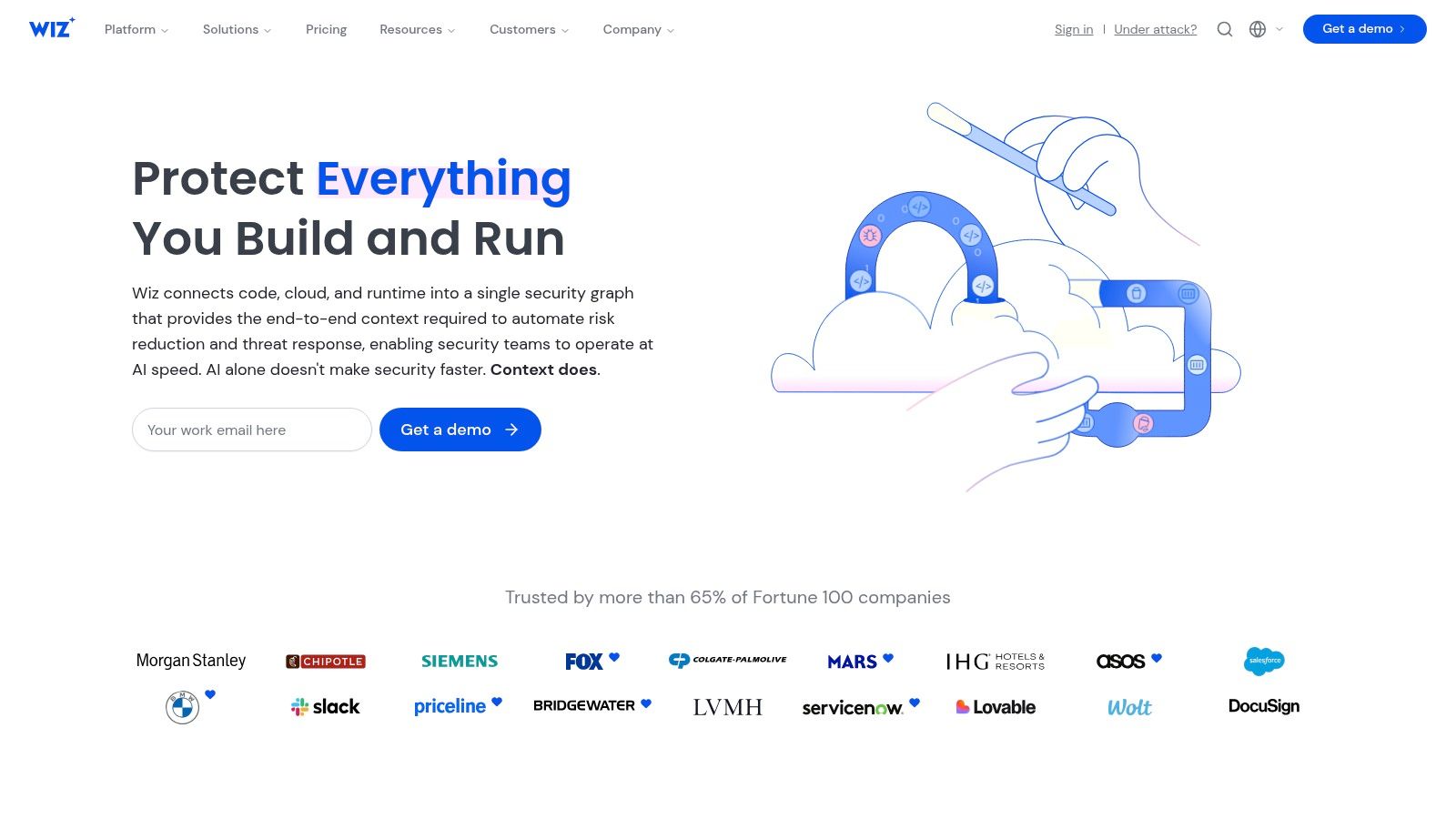
Wiz is strongest when the engagement starts with rapid, agentless discovery across a large estate. It builds a connected view of cloud resources, identities, workloads, networks, data, IaC, containers, and Kubernetes. The value for a pentest lead isn't the number of checks. It's the graph that connects an exposed resource to a role, a reachable workload, and a possible attack path.
That makes Wiz a read-only posture audit tool with attacker-oriented prioritization. Its toxic-combination analysis helps separate a harmless configuration violation from a chain that deserves manual validation. The platform supports AWS, Azure, GCP, and Kubernetes, which suits clients with several accounts and providers.
Where Wiz fits in an engagement
The best use is scope definition and triage. I'd use the graph to identify identities and resources that deserve controlled verification with an offensive tool. The agentless model also reduces deployment friction when a client won't permit agents in production.
The weakness is scope interpretation. A graph can show a credible path, but it doesn't automatically prove that exploitation is safe, authorized, or materially impactful. You still need a test boundary, a credential plan, and a human decision about whether to validate access to data.
Practical rule: Treat an attack path as a hypothesis until a controlled test confirms the privilege or access it represents.
Wiz's enterprise pricing is quote-based, so MSSPs should model tenant volume and reporting requirements before standardizing on it. The breadth can also create governance work. Teams need consistent suppression rules, ownership, and retesting procedures. For a comparison of posture management and broader exposure validation, see CNAPP versus CSPM.
Visit Wiz for the platform details.
2. Orca Security Agentless CNAPP
Orca is a practical choice when the client wants fast onboarding and one operational risk view. Its side-scanning approach provides agentless visibility into configurations, vulnerabilities, identities, malware indicators, and cloud assets. The result is useful during an initial assessment because the tester can build a broad inventory without changing workload behavior.
I classify Orca as a read-only posture audit platform. It works well for gathering evidence across AWS, Azure, and GCP, then organizing findings for security operations or compliance reporting. Its posture, vulnerability, and CIEM capabilities help connect an identity problem with a workload or service context instead of leaving the client with isolated alerts.
What Orca doesn't prove
Orca can show that a control is weak. It won't replace a manual attack path review or a live exploitation framework. A finding that looks severe in a dashboard may be unreachable because of a network boundary, a missing permission, a service condition, or a compensating control. That's where a pentester has to test the logic rather than accept the severity label.
The MSSP fit is good for consolidated client reporting. A provider can use the unified risk view to standardize account reviews and route remediation work. The trade-off is commercial and operational. Pricing isn't publicly transparent, and licensing can become difficult to compare when clients have different account structures or demand separate environments.
Use Orca to establish the environment's known exposure and evidence baseline. Pair it with attacker-view enumeration when the assessment needs privilege-chain analysis, and with live validation when the report must state what an attacker could reach.
Review Orca Security before planning an evaluation.
3. Palo Alto Networks Prisma Cloud CNAPP
Prisma Cloud is built for organizations that want a broad code-to-cloud control plane. It covers IaC scanning, posture management, CIEM, containers, Kubernetes, compliance policy, and runtime protection. The SaaS platform and self-hosted Compute Edition give enterprise teams different deployment options, which can matter when a client has strict operational or data-handling requirements.
Its engagement role is read-only posture audit with build and runtime context. Prisma Cloud can identify a problem before deployment, then connect it to the running workload. That helps a pentester explain whether a finding originated in IaC, appeared during deployment, or became exploitable because of runtime conditions.
The enterprise trade-off
The breadth is useful, but it creates configuration work. A client may have separate teams managing cloud posture, containers, developer pipelines, and runtime policy. Without clear ownership, the platform can produce a large queue of findings with no agreed remediation path. The tester should define which outputs belong in the penetration-test report and which belong in the client's continuous security program.
Prisma Cloud is a strong fit for MSSPs serving mature enterprises with existing Palo Alto Networks relationships. Marketplace trials and pay-as-you-go options can make evaluation easier, but larger deployments may carry significant licensing and operational cost. That doesn't make the tool unsuitable. It means the provider should assess the client's control model instead of buying the entire stack for a narrow assessment.
It also isn't an exploitation framework. It may identify a vulnerable container, risky admission policy, or excessive permission. It won't independently replace a controlled attempt to prove impact.
See Prisma Cloud for deployment and capability information.
4. Prowler Open Source and Prowler Cloud SaaS
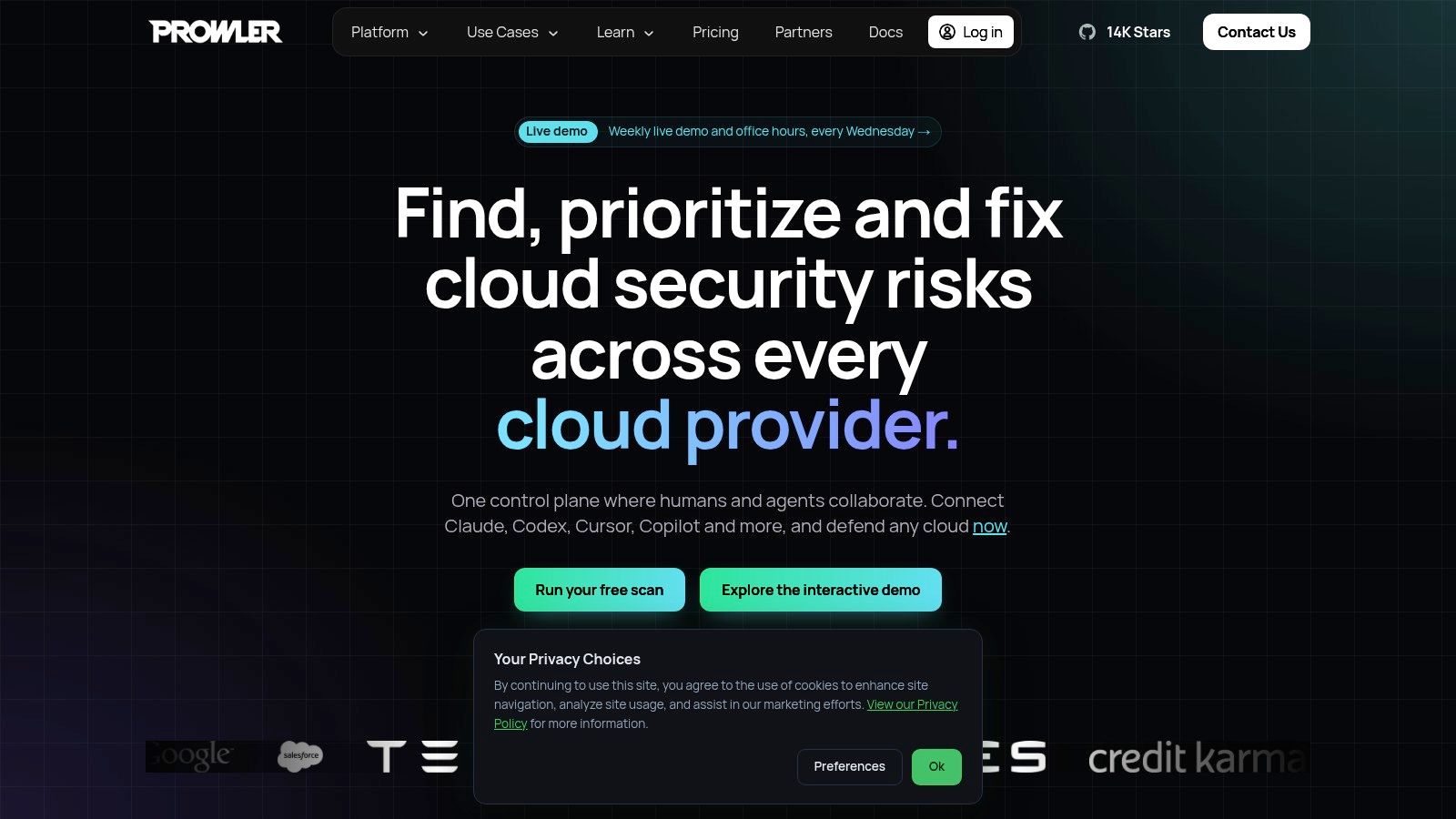
Prowler is one of the most useful choices for repeatable, compliance-mapped read-only assessments. The CLI runs checks across AWS, Azure, GCP, Kubernetes, Microsoft 365, and GitHub. Its outputs can be written to JSON, CSV, or HTML, which makes it easy to preserve evidence, feed a pipeline, or attach results to a client deliverable.
I use Prowler when the engagement needs a dependable baseline quickly. It maps checks to CIS, NIST, PCI-DSS, SOC 2, HIPAA, and other frameworks. The commercial Prowler Cloud layer adds centralized dashboards, trends, and multi-account management. That split is useful for MSSPs because the CLI can support project work while the SaaS product supports recurring operations.
Why providers keep it in the toolkit
The automation is the main advantage. Prowler fits CI/CD checks, scheduled reviews, and account onboarding. It also gives junior consultants a structured starting point. The limitation is that a compliance pass is not an exploitability result. A failed check may identify a control gap without showing a viable attack path.
The open-source version also requires the provider to manage storage, dashboards, credentials, and report handling. Checks may need tuning for account-specific architecture. A public test account, a regulated production account, and a shared platform account shouldn't necessarily use identical exceptions.
“A compliance result is evidence of a condition, not proof of compromise.”
Use Prowler to define the assessment surface and identify controls that deserve deeper testing. For a wider view of assessment workflows and tooling, see these cloud security assessment tools.
Explore Prowler for the open-source and SaaS options.
5. NCC Group ScoutSuite Open Source
ScoutSuite remains a strong consulting tool because it does one job cleanly. It performs read-only API-based cloud audits across AWS, Azure, and GCP, then produces an interactive HTML report that a tester can archive and use during client review.
The report format is especially useful in penetration testing. It gives the consultant a visual evidence package for identity, networking, storage, and service configuration. It's lightweight, fast to run, and easy to hand to another tester for review. That matters when the assessment has a short discovery window or when a client wants to reproduce the collection process.
ScoutSuite's boundary
ScoutSuite is not an exploitation framework. It won't validate whether an excessive permission can be used to access a specific resource, and it won't simulate post-exploitation behavior. Its value is in showing the account's posture at the time of collection.
That boundary makes it a good first-pass tool for a red or purple team. Run it with tightly scoped read-only credentials, preserve the generated report, then select findings for manual verification. Don't present every failed rule as a confirmed vulnerability. A client will challenge the report if the tester can't explain reachability, affected identities, or the evidence behind the impact statement.
Custom report formatting beyond the defaults can require scripting. MSSPs that need branded, multi-tenant reporting may need a separate reporting layer. Even so, ScoutSuite's simplicity is an advantage when the goal is transparent evidence rather than a large commercial dashboard.
6. Steampipe and Compliance Mods by Turbot
Steampipe is for testers who want to ask direct questions of cloud APIs using SQL. It turns cloud and SaaS resources into queryable tables, then uses open-source compliance mods to produce checks, dashboards, and reports. That makes it a scriptable read-only audit and evidence tool, not a packaged exploitation platform.
The SQL model works well for consulting teams. A tester can write a query for a client's specific account structure, reuse it across engagements, and export results in HTML or JSON. The compliance library supports AWS, Azure, GCP, Kubernetes, and other providers, with benchmarks mapped to frameworks such as CIS, NIST, PCI-DSS, SOC 2, HIPAA, and FedRAMP.
Where it saves time
Steampipe is effective when the assessment needs custom evidence. Instead of navigating several provider consoles, the consultant can query identity relationships, public exposure, encryption settings, network controls, or resource ownership in a repeatable way. That query becomes part of the engagement record and can be rerun after remediation.
The price is skill and setup. Junior testers need SQL familiarity, and each client may require credential, plugin, and exception handling. Steampipe also doesn't prove that a misconfiguration is exploitable. It gives you the data needed to decide what to test next.
For MSSPs, it fits best as a reusable evidence layer behind a consulting methodology. It can support client-specific controls without forcing every customer into the same dashboard. It won't replace a tool that performs attacker-view enumeration or live validation.
Visit Steampipe to review its query and compliance model.
7. Bishop Fox CloudFox Cloud Enumeration for Pentesting
CloudFox is purpose-built for the part of a pentest that many posture products handle poorly: attacker-view enumeration. It helps map identities, roles, network paths, permissions, and cloud relationships in AWS, Azure, and GCP. The output gives an offensive tester a faster way to understand where a compromised identity might move.
I'd run CloudFox after establishing authorized credentials and target scope. Its filters and queries help surface privilege chains and misconfigurations that deserve manual review. That makes it useful for reconnaissance and attack-path mapping, especially when the account contains many roles and services.
What CloudFox leaves to the tester
CloudFox discovers and organizes. It doesn't complete the exploitation workflow. The tester still needs to decide whether to use Pacu, Stratus Red Team, provider-native calls, or manual techniques to verify the path. That separation is healthy. Enumeration and exploitation have different safety requirements, and a discovery command shouldn't automatically trigger a potentially disruptive action.
The CLI approach also creates a learning curve for junior staff. MSSPs should standardize credential profiles, output naming, evidence storage, and rules for handling secrets or sensitive resource metadata. Without that discipline, a useful recon tool can create inconsistent notes across consultants.
CloudFox is especially valuable when the report needs to explain how an attacker could move from a low-privilege identity toward a sensitive resource. It's less useful as a standalone compliance deliverable because its output is designed for offensive reasoning rather than executive posture reporting.
8. Pacu AWS Exploitation Framework
A client gives you an IAM user, a narrow scope, and one question: can any of this be abused without breaking production? That is Pacu's job. I classify it as a live attack validation tool for AWS. It goes past posture review and attacker-view enumeration, and into controlled exploitation. The framework includes modules for enumeration, privilege escalation, credential abuse, data access, and post-exploitation. Its session model and logging are useful when you need to replay steps, preserve evidence, and explain exactly what happened.
Pacu fits engagements where actual value is verified impact. It is strong against misconfigured IAM, excessive permissions, and credential paths that look dangerous on paper but need proof. That matters for client sign-off. A confirmed action usually carries more weight than a theoretical finding, as long as the operator stayed inside scope and captured the minimum evidence needed.
Guardrails are mandatory
Pacu can change real resources and trigger real consequences. Use it only with written authorization, named accounts, credential limits, stop conditions, and an escalation contact. I prefer isolated resources and non-sensitive test data. If customer data is in play, prove access with the smallest safe artifact, then stop.
AWS allows penetration testing against specified services without prior approval, but some techniques remain restricted. AWS's penetration-testing rules make that clear. Command-and-control testing needs prior approval, and denial-of-service activity against AWS assets is prohibited. Provider policy is part of technical scope, not paperwork after the test.
For MSSPs, that delivery model is the trade-off. Pacu can produce high-confidence findings, but it does not fit broad, read-only assessments or junior-led recurring reviews. It is AWS-only, and a module that is safe in a lab can create very different effects in a client account because of logging, automation, and downstream trust relationships.
Use Pacu when the engagement needs proof of exploitability. Use something else for posture inventory.
9. Stratus Red Team Cloud Attack Simulation
Stratus Red Team sits between a penetration test and a detection-engineering exercise. It safely detonates mapped cloud attack techniques in live AWS, Azure, and GCP environments, then performs cleanup intended to reduce residual risk. I classify it as a live attack validation and purple-team tool.
The important distinction is repeatability. A detection team can run a known technique, check whether logs and alerts appear, and validate SIEM or SOAR controls. A pentester can use the same workflow to confirm that a guardrail blocks or detects a behavior. The technique mapping also makes the result easier to explain than an improvised command sequence.
Live simulation still changes the environment
Cleanup helps, but it doesn't remove the need for strict scope. Cloud activity can trigger alerts, automation, billing events, forensic collection, or incident response. Define accounts, regions, resources, identities, schedules, and stop conditions before detonation. Notify the people who may receive the alerts, unless the engagement explicitly includes an authorized blind exercise.
Stratus doesn't replace a posture scanner. It won't give you a complete inventory of misconfigurations, and it isn't a general vulnerability management platform. It proves whether selected techniques create the expected activity and whether controls respond.
That makes it a strong fit for purple teams and MSSPs that sell recurring detection validation. It's less suitable as the only tool in a client's cloud penetration test. Pair it with a posture baseline and attacker-view enumeration so the simulations reflect the client's actual identity and network paths.
10. ThreatExploit AI
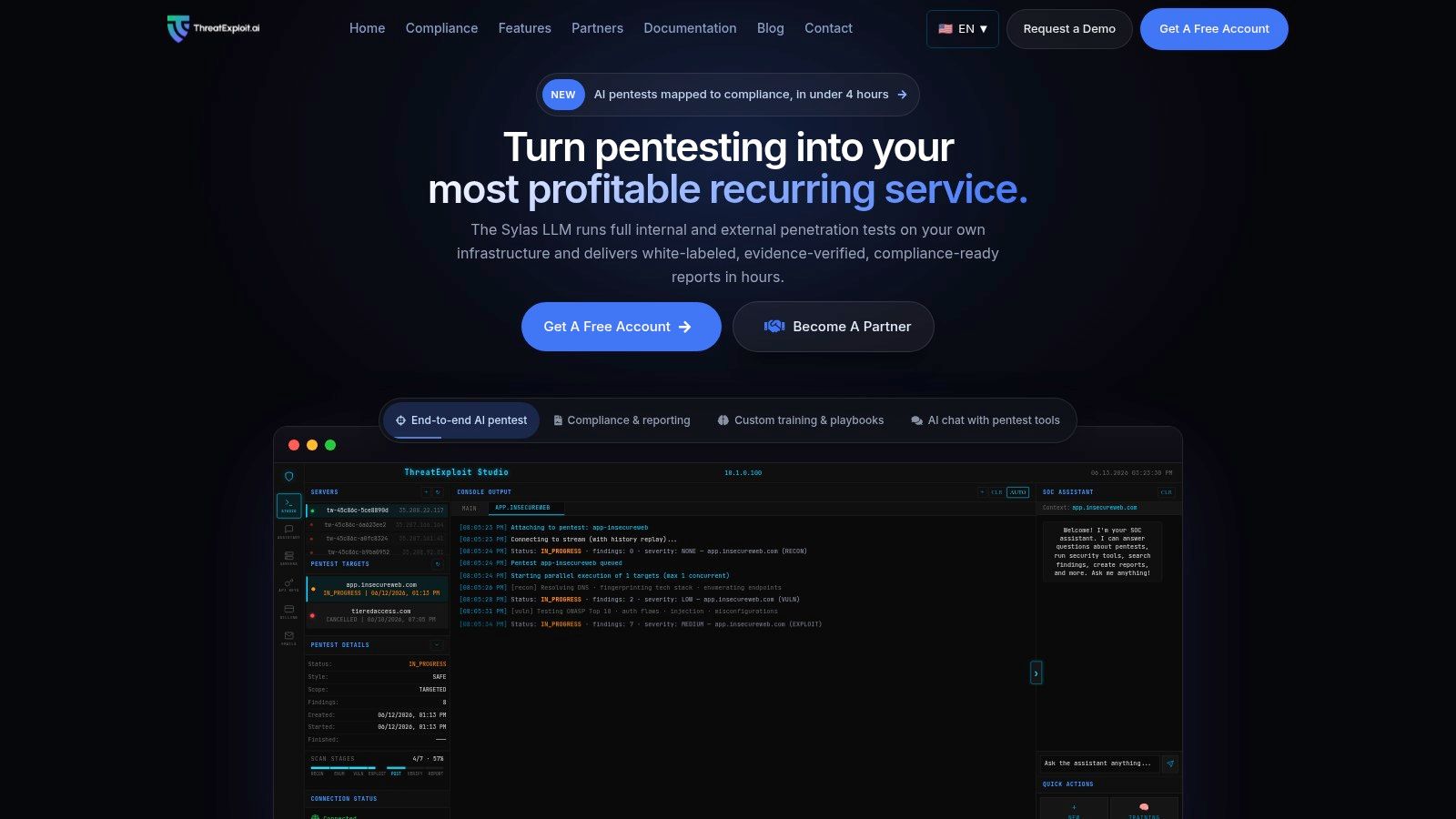
A client gives you a narrow cloud pentest window, wants proof for each finding, and expects a report their security team can act on the same day. That is the use case ThreatExploit AI is built for. I classify it as a live attack validation platform first, with enough orchestration around it to support repeatable MSSP delivery rather than one-off operator workflows.
It covers AWS, Azure, and GCP, and coordinates reconnaissance, scanning, exploitation, verification, and reporting through an agentic controller. The platform combines a pentest-trained language model with more than 60 open-source and proprietary tools, including Nmap, SQLMap, and Nuclei. In practice, that matters less for feature count than for engagement role. This is not a read-only posture audit tool, and it is not just attacker-view enumeration. It is built to execute in scope, verify impact, and package the evidence.
The workflow maps to all seven PTES phases: pre-engagement interactions, intelligence gathering, threat modeling, vulnerability analysis, exploitation, post-exploitation, and reporting. For teams that need a defensible method, that structure helps. OWASP's testing framework points to PTES technical guidelines as a practical basis for testing procedures and tool evaluation.
Where it fits for MSSPs
For MSSPs, the delivery fit is clear. ThreatExploit AI is aimed at providers that need repeatable customer operations, controlled infrastructure, and consistent outputs across accounts. It offers dedicated, non-multi-tenant pentest servers with deployment options across America, Europe, and Asia. It also includes a partner dashboard for onboarding customers and managing reporting across tenants. API and CI/CD integrations, a VS Code extension, role-based permissions, and optional on-premise deployment help it fit into existing operating controls.
The reporting side is the main reason to consider it. According to the platform's stated product information, typical workflows can produce evidence-backed PDF and JSON reports in under four hours, with a reported 95% finding verification rate and 94% overall accuracy. Treat those as vendor claims. The practical test is simpler. Can your reviewer inspect the evidence, reproduce the steps, and decide whether the finding is ready for the client report?
Reports include executive and technical views, screenshots, remediation steps, and structured exports. Findings can map to HIPAA, SOC 2, PCI-DSS, CMMC, ISO 27001, GLBA, and GDPR control references. For PCI-DSS engagements, that mapping is useful because recurring testing has a fixed cadence and evidence burden. The PCI-DSS testing requirements summarize the schedule and requirement references.
The trade-off is scope control
The upside is throughput. A provider can reduce handoffs between recon, validation, and reporting, and handle recurring cloud assessments without assigning a senior pentester to every routine test. That makes sense for MSSPs selling repeatable assessments, compliance-driven testing, and prospecting engagements where report quality still matters.
The scoping risk is higher than with read-only audit tools. Once a platform moves from enumeration into exploitation and validation, provider discipline matters more than product automation. Novel red-team goals, business-logic abuse, unusual trust relationships, and multi-step attack chains still need expert review. Cloud provider rules still apply too. AWS allows certain customer assessments, but some activities require extra care or approval. A platform like this has to inherit those limits and your rules of engagement.
Pricing is set per test and volume tier, with no public per-seat price. That can fit an MSSP resale model, but buyers should confirm rates, margins, infrastructure terms, data-handling conditions, and support commitments before they commit.
Top 10 Cloud Testing Tools: Feature Comparison
| Product | Core focus & scope | Key capabilities ✨ | Quality & Verification ★ | Target audience 👥 | Pricing & Value 💰 |
|---|---|---|---|---|---|
| Wiz, Cloud and AI Security Platform (CNAPP) | Agentless CNAPP: code→cloud across AWS/Azure/GCP & K8s | ✨ Graph-based attack‑path & blast‑radius, IaC→runtime analytics, broad integrations | ★★★★ | 👥 Enterprise cloud/security teams | 💰 Enterprise/quote-based; strong at scale |
| Orca Security, Agentless CNAPP | Agentless full‑stack cloud visibility and risk correlation | ✨ Side‑scanning, unified vuln+posture+CIEM, compliance reports | ★★★★ | 👥 SecOps, cloud ops, fast adopters | 💰 Quote-based; fast time‑to‑value |
| Palo Alto Prisma Cloud, CNAPP | Full CNAPP (SaaS + self‑hosted Compute Edition) | ✨ IaC scanning → runtime protection, admission controls, compliance packs | ★★★★ | 👥 Large enterprises, dev+cloud teams | 💰 Marketplace/PAYG options; enterprise pricing |
| Prowler (OSS) / Prowler Cloud (SaaS) | Open‑source compliance & posture scanner (multi‑cloud) | ✨ CLI checks, CI/CD outputs, wide CIS/NIST/PCI/SOC mapping | ★★★ | 👥 Auditors, DevSecOps, consultants | 💰 OSS = free; Prowler Cloud = SaaS pricing |
| NCC Group ScoutSuite (Open Source) | Read‑only multi‑cloud posture auditing & evidence reports | ✨ Interactive HTML evidence reports, extensible rules | ★★★ | 👥 Red/purple teams, consultants | 💰 Free OSS; self‑hosted reporting costs |
| Steampipe + Compliance Mods | SQL-driven cloud API queries & compliance benchmarking | ✨ Query cloud APIs as Postgres tables, large compliance mods | ★★★ | 👥 Auditors, consultants, scriptable ops | 💰 OSS core; enterprise support available |
| Bishop Fox CloudFox (OSS) | Cloud enumeration focused on exploitable paths (multi‑cloud) | ✨ Privilege‑chain filters, attack‑path enumeration, pentest outputs | ★★★ | 👥 Penetration testers, red teams | 💰 Free OSS; integrates with paid tools |
| Pacu, AWS Exploitation Framework (OSS) | Offensive AWS exploitation & validation framework | ✨ Modules for enumeration, escalation, post‑exploitation, logging | ★★★ | 👥 AWS pentesters, red teams | 💰 Free OSS; requires isolated test accounts |
| Stratus Red Team, Cloud Attack Simulation (OSS) | Technique‑mapped cloud detonations for detection validation | ✨ Safe detonations with cleanup, mapped TTPs for purple teams | ★★★★ | 👥 Detection engineers, purple teams | 💰 Free OSS; operational scoping required |
| 🏆 ThreatExploit AI | Autonomous end‑to‑end pentesting across web, network & cloud; evidence + compliance | ✨ Full automation recon→exploit→verify→report, 60+ toolchain, control‑level compliance mapping | ★★★★★ (≈94% verification) | 👥 MSSPs, MSPs, telecoms, hosting & compliance firms | 💰 Free trials; partner/volume pricing per test (contact sales) |
Building a Cloud Testing Stack That Holds Up Under Client Review
The strongest stack doesn't come from choosing the tool with the longest feature list. It comes from assigning each tool a clear engagement role and preserving the evidence that connects one role to the next.
Start with posture scanning. Wiz, Orca, Prisma Cloud, Prowler, ScoutSuite, and Steampipe can establish the account's configuration, identity, network, workload, and compliance baseline. That baseline defines scope. It also gives the client a record of what existed when the test began. Use read-only credentials wherever possible, record account and region boundaries, and save JSON or HTML output with timestamps and tool versions.
Add attacker-view enumeration when the test needs more than a list of violations. CloudFox can map identity relationships, privilege chains, network paths, and reachable services. Here, the tester turns a posture finding into an attack hypothesis. A public resource is not automatically a compromise, and an excessive permission is not automatically an exploitable path. Validate the conditions before assigning business impact.
Use live attack validation selectively. Pacu is appropriate for controlled AWS exploitation. Stratus Red Team is useful for repeatable cloud attack simulations and detection validation. ThreatExploit AI can coordinate a broader end-to-end workflow across AWS, Azure, and GCP, then produce evidence-backed reports for service delivery. In every case, define the target, technique, credential, data-access, and stop conditions before execution.
MSSPs should also design for the operating burden. The 2025 SANS Detection and Response Survey reported limited cloud expertise as a detection challenge for 58% of respondents, while 53% cited both multicloud complexity and tool integration. False positives remain a major operational burden. Buying another dashboard won't fix inconsistent scope, duplicate findings, weak evidence handling, or unclear ownership.
Keep a human reviewer on novel attack chains and business-logic risks. Review every finding that claims access to sensitive data, privilege escalation, persistence, or cross-account movement. Treat automated cleanup as helpful, not guaranteed. Retest after remediation and preserve the before-and-after evidence.
Cloud growth makes this discipline more important. Gartner forecast public cloud end-user spending at $723.4 billion in 2025, compared with $595.7 billion in 2024, a year-over-year increase of approximately $127.7 billion, or 21.4% according to Gartner's forecast. More programmable infrastructure means more identities, APIs, workloads, and deployment paths to test. A stack that only reports configuration failures won't keep pace with that operating reality.
ThreatExploit AI gives MSSPs an end-to-end cloud penetration-testing workflow across AWS, Azure, and GCP, with autonomous reconnaissance, exploitation, verification, and evidence-backed reporting. If you need repeatable assessments that connect live validation to client-ready compliance outputs, visit ThreatExploit AI and evaluate its partner delivery model.