
Vulnerability exploitation accounted for 20% of confirmed breaches in Verizon's 2025 DBIR, a 34% increase from the prior year, based on more than 22,000 incidents, including 12,195 confirmed breaches (Verizon's executive summary). For a penetration testing provider, that reframes the detection question: can the customer's defenders recognize a successful exploitation chain, or can they only show that their tools generated alerts?
Table of Contents
- Why AI Driven Threat Detection Is Now Foundational
- The Threat Environment Driving AI Driven Threat Detection
- Core Architecture of an AI Driven Threat Detection Stack
- Evaluating AI Driven Threat Detection as an Investigation
- Adversarial Risks and Hardening for AI Driven Threat Detection
- Operational Metrics Beyond Accuracy
- Buyer and Vendor Selection Criteria for MSSPs and Consultancies
- 2026 Outlook and an Implementation Checklist
Why AI Driven Threat Detection Is Now Foundational
AI driven threat detection means using models to identify suspicious behavior, connect related evidence, and support decisions about what to investigate. In penetration testing, its value should be demonstrated against authorized attack activity, not inferred from a vendor's accuracy score.
A scanner identifies potential exposure. A penetration test establishes whether an attacker can exploit that exposure within an agreed scope. Detection validation asks a separate question: did the defensive stack recognize the behavior, associate it with the right assets, and give a responder enough evidence to act?
Separate investigation from alert generation
AI isn't a replacement name for a SIEM. Treat the SIEM as a telemetry and analytics foundation, then evaluate where models add useful capabilities: identifying unusual behavior, proposing investigative queries, connecting entities, or summarizing evidence. Keep deterministic rules when they express a known condition clearly and reliably.
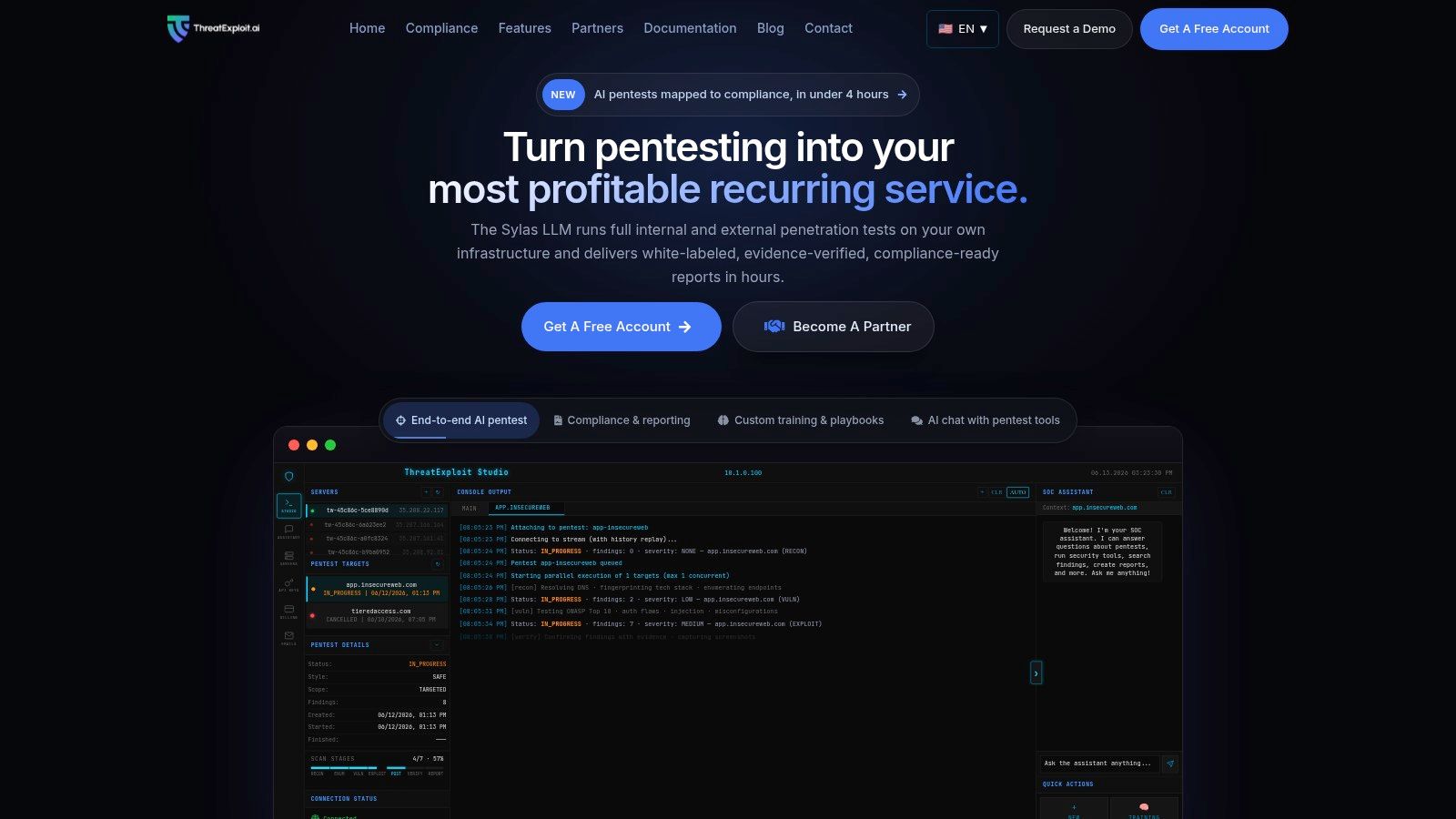
For providers, the practical opportunity is to connect offensive evidence with defensive investigation. An exploitation result should become a testable observation, not merely another finding in a PDF. The screenshot below provides a penetration testing platform reference for that workflow.
Who Should Read This Guide and What They Will Get
| Audience | Core Decision Enabled |
|---|---|
| MSSPs and security consultancies | Decide whether AI improves investigation and detection validation |
| MSPs expanding into security | Establish safe boundaries between testing, monitoring, and response |
| Telecom and communications providers | Define evidence and isolation requirements for business customers |
| Hosting and cloud infrastructure providers | Select telemetry and validation workflows across customer environments |
| Compliance and audit firms | Distinguish reproducible technical evidence from unsupported assurance claims |
The procurement decision therefore spans architecture, investigative evaluation, adversarial resilience, analyst workload, and reporting. Don't buy autonomy before defining what a correct, authorized, independently verifiable investigation looks like.
Practical rule: A detected penetration test technique isn't a useful outcome unless a responder can identify what happened, where it happened, and what evidence supports the conclusion.
The Threat Environment Driving AI Driven Threat Detection
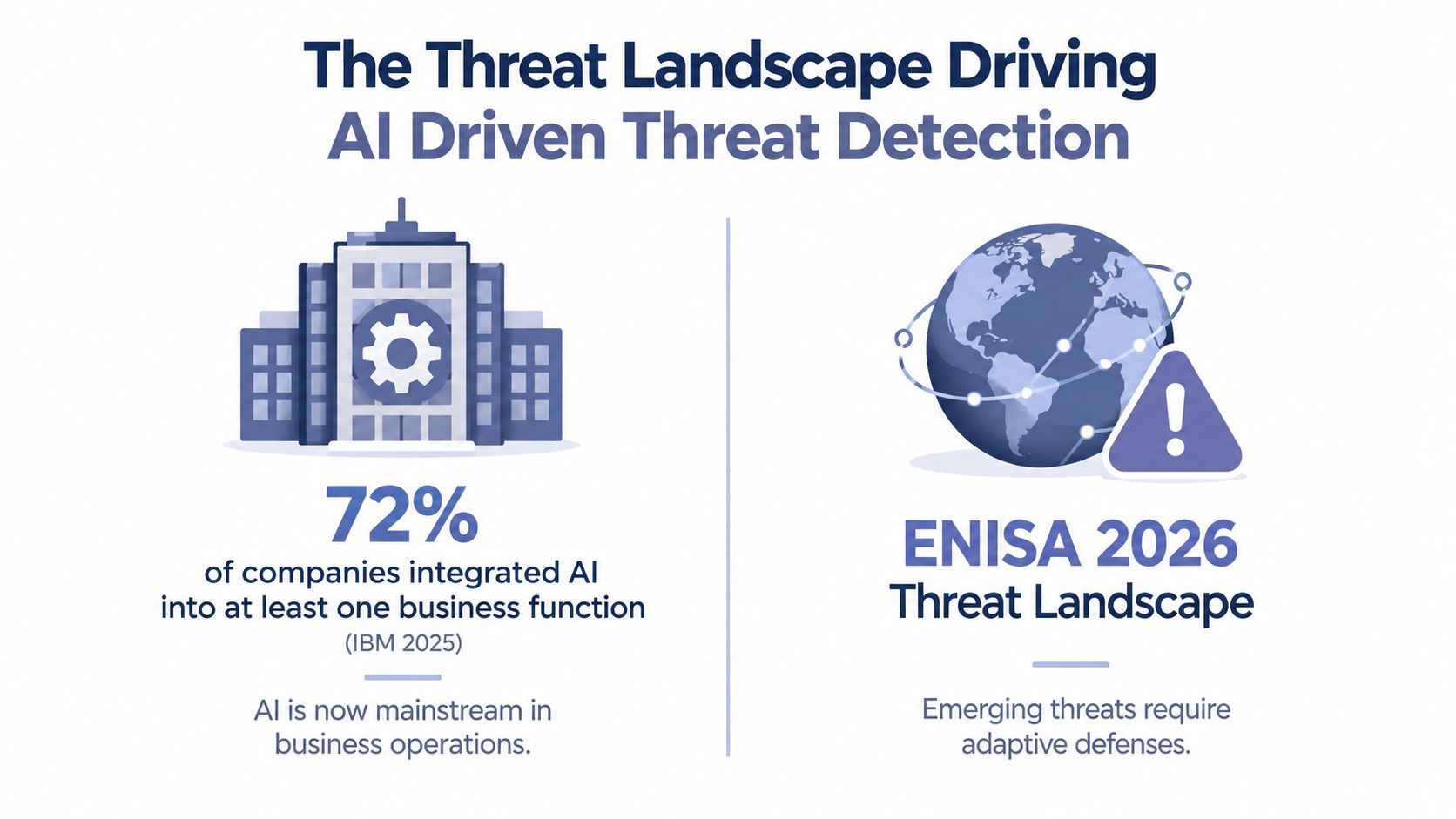
IBM's 2025 X-Force assessment reported that 72% of companies integrated AI into a business function in 2024, a 55% increase from the previous year; it also described attackers using public AI tools for coding, automation, phishing content, and malicious operations (IBM X-Force findings reported by Network World). Adoption on that scale expands both what providers must protect and what attackers can co-opt.
The same assessment found that large-scale attacks directly targeting AI technologies hadn't materialized yet, although researchers had already identified vulnerabilities in agent-building frameworks. Read that as a coverage problem rather than a reprieve: established attack paths still carry most of the risk, and AI services add new identities, permissions, and interfaces that any investigation has to account for.
The comparison below captures the relationship between business adoption and defensive scope.
Detect acceleration and compromise separately
ENISA's 2026 analysis of the EU threat picture covered 8,257 incidents recorded during 2025, identifying ransomware, exploitation, and growing adversarial AI use as major features; 51% involved low-impact DDoS activity, while 40% resulted in unauthorized access (ENISA Threat Landscape resource).
Those figures describe different investigations. A DDoS event produces loud, high-volume telemetry and a short containment decision. Unauthorized access produces a quiet trail that only becomes clear when authentication, process, and data records get correlated. If a detection stack pushes both down the same triage path, the noisy half of the queue absorbs analyst hours while the consequential half waits. That is alert-fatigue economics in practice.
For penetration testing teams, the follow-on is concrete. Run authorized emulations mapped to ATT&CK-style techniques against customer-specific telemetry, then check two things: whether defenders separate a noisy probe from successful access, and whether the detection output lets an analyst reconstruct what happened after that access rather than restate that an alert fired.
What Defenders Must Detect in an AI Saturated Environment
| Traditional Signal | AI Specific Signal |
|---|---|
| Unusual authentication | Unauthorized use of model or agent credentials |
| Unexpected process execution | Agent actions outside its permitted workflow |
| Unusual data movement | Unexpected retrieval or disclosure through AI interfaces |
| Malicious application input | Prompt manipulation directed at connected tools |
| Abnormal service usage | Unexpected model invocation patterns or API activity |
Providers assessing AI-powered cyberattacks and defensive AI should treat AI services as first-class investigation subjects, with visibility into their identities, invocation patterns, and connected tools, instead of bolting an indicator feed onto existing rules.
Annual assessments remain useful checkpoints, though validation should also trigger on material change: new exposed services, shifted identity permissions, added agent integrations, modified logging configurations. Each change rewrites what a correct investigation needs to observe.
Core Architecture of an AI Driven Threat Detection Stack
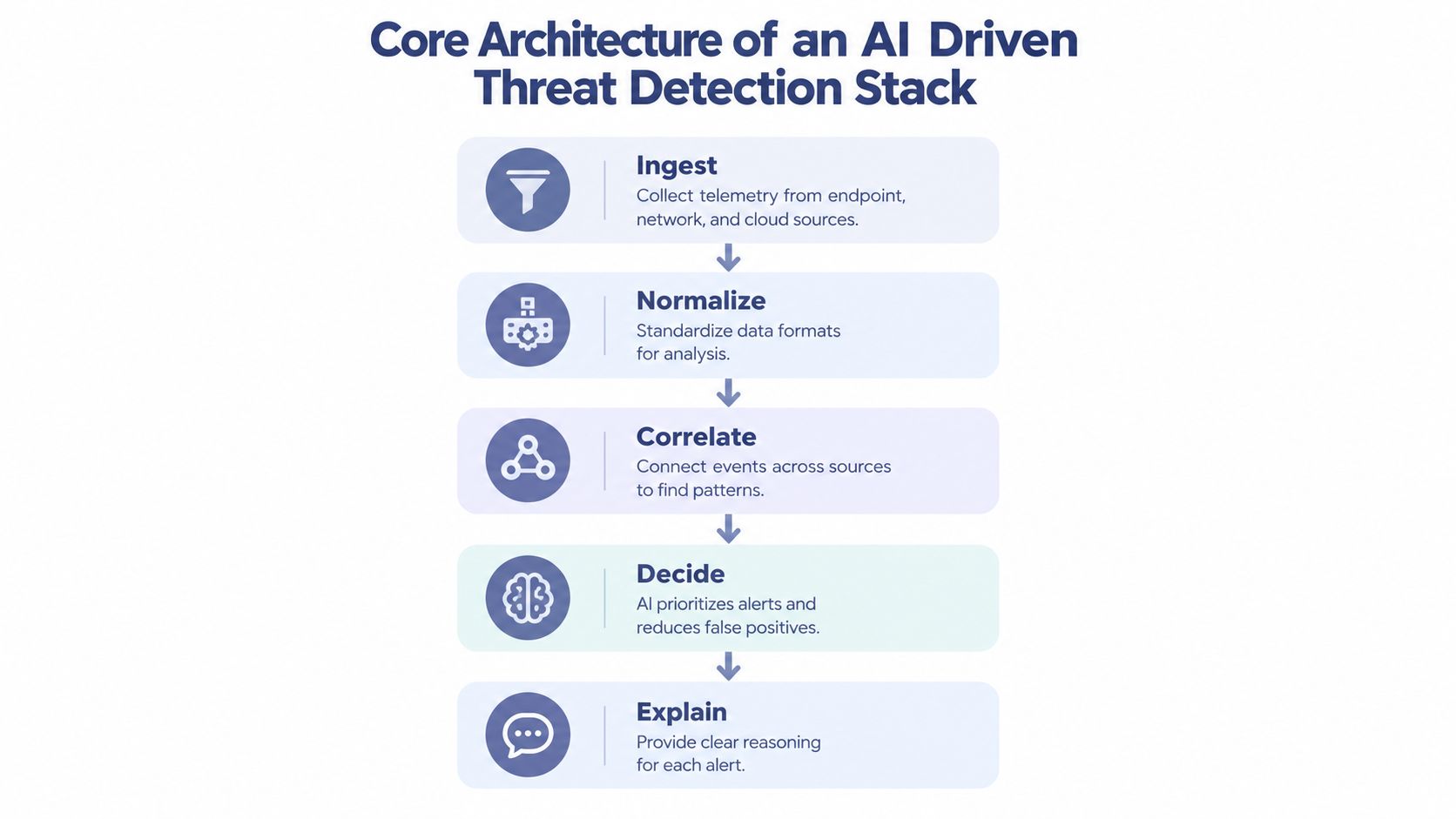
Build the stack like an investigation team: collect observations, reconcile identities, connect activity, choose the next action, and explain the result. Don't begin with a model and search for somewhere to insert it.
The architecture below shows the processing sequence, not a promise that every stage should be autonomous.
Establish the evidence foundation
Ingest and normalize endpoint, network, identity, cloud, application, and AI-system logs. Preserve original records alongside normalized fields. A provider should be able to distinguish missing telemetry from a model's failure to interpret available telemetry.
Require schema-tolerant ingestion without silent substitution. If a connector can't resolve an account identifier or event timestamp, expose that limitation rather than generating a confident narrative. For teams aligning on foundational terminology, Ciphar's intrusion detection explained is a supplementary resource.
Separate model responsibilities. Use supervised classifiers for defined categories, anomaly detection for deviations from a customer baseline, and language models for constrained summarization or query assistance. Retrieval-augmented reasoning should reference approved evidence and knowledge, with clear separation between retrieved content and executable instructions.
Correlate before deciding
Microsoft's ExCyTIn-Bench models investigation across 57 log tables, evaluating whether an agent chooses useful investigative actions rather than merely returning a binary answer (Microsoft's cybersecurity evaluation methodology). That framing supports an architecture in which intermediate actions are inspectable.
Represent relationships explicitly: a test action produced an artifact, an endpoint recorded a process, an identity accessed a resource, and a detection referenced those entities. An evidence graph should preserve those relationships without converting an uncertain inference into an observed fact.
When comparing a security orchestration platform, ask how the orchestration layer carries evidence and authorization between tools. The accompanying video provides an additional workflow reference.
For an MSSP, deployment boundaries matter as much as model selection:
- Tenant separation: Restrict retrieval, credentials, evidence storage, and reporting to the correct customer.
- Isolated execution: Run testing tools separately from reasoning components and unrelated customer workloads.
- Inspectable outputs: Retain queries, tool responses, uncertainty, and approval decisions.
- Explicit response authority: Distinguish enrichment, prioritization, anomaly detection, and autonomous response. Permission to summarize an incident isn't permission to contain an asset.
Evaluating AI Driven Threat Detection as an Investigation
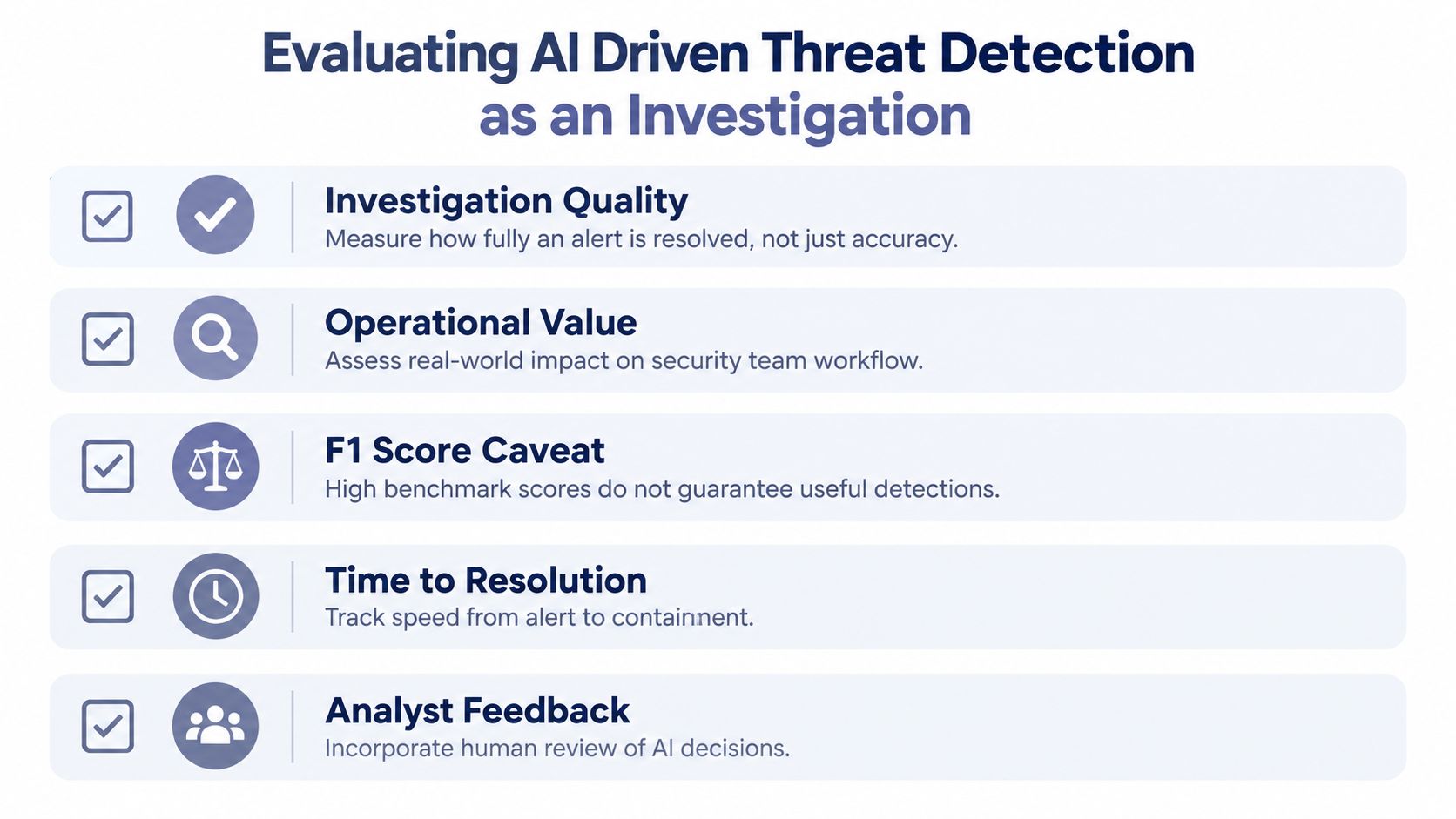
A high F1 score doesn't establish that a system can investigate a customer incident. It doesn't tell you whether the model queried the correct table, confused similarly named accounts, or escalated a conclusion that the retained logs can't support.
Use a proof of concept with an agreed attack narrative, authorized execution boundaries, expected observables, and benign comparison activity. Keep the ground truth independent of the detector being evaluated.
The checklist below emphasizes operational assessment rather than a single classification result.
Use attack chains as the test unit
MITRE's adversary-emulation methodology evaluates complete attack chains from initial access through impact, checks detections against adversary techniques, and includes false-positive test cases alongside malicious activity. Adapt that approach to each customer's environment rather than treating an ATT&CK mapping as proof of complete coverage.
For each authorized technique, record the execution time, exact action, affected entities, artifacts, expected data sources, and observed defensive output. If telemetry is absent, classify the result as an observability gap. If telemetry exists but the investigation fails, identify the failed reasoning or detection step.
| Evaluation Metric | What the Provider Should Record |
|---|---|
| Detection latency | Elapsed time from test action to actionable detection |
| Investigative action quality | Whether each query or tool action advances a defensible hypothesis |
| Query validity | Whether queries execute and use the intended fields and constraints |
| Entity coverage | Whether the investigation includes relevant identities, assets, and resources |
| Escalation precision | Whether escalations merit analyst attention under agreed criteria |
| Evidence retention | Whether another analyst can reconstruct the conclusion |
The earlier Microsoft benchmark provides the investigative framing; the customer proof of concept must supply environmental realism. Include incomplete logs, benign administrative activity, and schema differences rather than testing only clean attack traces.
Evaluate the next investigative action, not just the final answer. A correct conclusion reached through unsupported reasoning is difficult to reproduce or defend.
Where testing hands off to an external response team, use We Fix PC Laptop's MDR security service overview as a supplementary orientation resource. Define the actual handoff contract separately: who receives the evidence, who confirms the incident, and who can authorize containment.
Adversarial Risks and Hardening for AI Driven Threat Detection
Treat the detection model, its inputs, and its tool interfaces as attack surfaces. In an autonomous pentest pipeline, an attacker-controlled page or tool response must not become an instruction because an agent reads it.
NIST's adversarial machine learning taxonomy identifies evasion, poisoning, privacy, and misuse attacks across predictive and generative AI. It covers supervised, unsupervised, semi-supervised, federated, and reinforcement-learning systems, framing mitigation across the lifecycle rather than around an isolated accuracy score.
Map manipulation to operational consequences
Evasion targets inference-time behavior. Poisoning targets training data, model weights, or other learning inputs. Privacy attacks seek sensitive information, while misuse repurposes exposed capabilities.
For penetration testing, the consequence can extend beyond a wrong label. A manipulated intermediate result could lead an agent to claim access it never achieved, retrieve unrelated customer information, or propose an action outside the engagement scope. Put verification between observation and execution.
Adversarial Risks and Operational Controls Mapped to the AI Lifecycle
| Risk Category | Operational Control |
|---|---|
| Evasion | Test adversarial input variants and compare conclusions against independent telemetry |
| Poisoning | Track dataset and model provenance; verify cryptographic hashes and signed artifacts |
| Privacy | Limit retrieval scope, minimize retained sensitive data, and enforce tenant-specific access |
| Misuse | Restrict tool permissions, outbound access, target scope, and high-impact actions |
| Cross-stage propagation | Validate intermediate results before allowing dependent execution |
A signed artifact establishes integrity relative to a trusted signer; it doesn't establish that its contents are correct. Likewise, isolated execution limits consequences but doesn't make a model's conclusions trustworthy. Use both controls without confusing their purposes.
Ship detection for the detector
Monitor inference and API behavior as production security telemetry. The deployment should flag suspicious usage rather than assuming the AI control plane is trusted.
- Usage anomalies: Investigate excessive API calls, unexpected invocation patterns, and unusual outputs.
- Data-access anomalies: Review retrieval outside the expected customer, repository, or engagement.
- Instruction attacks: Detect prompt-injection attempts and jailbreak-like behavior in untrusted content.
- Regression failures: Re-run adversarial tests after model, prompt, connector, or tool changes.
- High-impact findings: Require independent verification before reporting confirmed compromise or executing consequential follow-up actions.
Authorization boundary: A model-generated recommendation can propose an action. Only the engagement's policy and approval controls should authorize it.
Keep these checks inside the penetration testing quality program. Reviewing report prose alone won't reveal whether an earlier tool response improperly changed the agent's behavior.
Operational Metrics Beyond Accuracy
False-positive reduction is an operational claim, not a synonym for fewer alerts. SANS reported false positives as the leading detection challenge for 73% of respondents in 2025, up from 64% in 2024; 60% encountered them frequently or very frequently, and 20% at very high rates, even as 90% used automated detection tools and 76% planned to expand AI/ML adoption (SANS detection and response research).
Those findings justify a skeptical workload assessment. A model that adds context to every low-value alert may improve presentation while leaving analysts with the same queue and more text to read.
Contrast enriched noise with disciplined triage
Consider a hypothetical noisy SOC. An AI assistant adds a polished summary to every unusual authentication alert, but analysts still reopen the identity console and endpoint timeline because the summaries omit supporting records. The provider has automated narration, not investigation.
In a hypothetical disciplined SOC, the assistant attaches event references, checks the relevant customer baseline, and states what evidence would disprove its hypothesis. Analysts accept or reject its proposed disposition, and reviewers sample suppressed alerts. These are workflow illustrations, not reported customer outcomes.
The difference should appear in measurements:
- Analyst-accepted alert rate: Track how often analysts accept the proposed disposition, recording disagreement reasons.
- Alert-to-investigation conversion: Measure whether surfaced alerts justify a substantive investigation under consistent criteria.
- Suppression error rate: Review sampled suppressed activity for cases that should have been investigated.
- Time to validated incident: Measure the path to an evidence-supported determination, not merely initial alert creation.
- Missed-attack sampling: Compare authorized test activity with what the system surfaced, including attacks that never generated an alert.
Account for review and rework
For an MSSP, evaluate analyst effort across enrichment, investigation, correction, reporting, and customer explanation. Don't count a suppressed alert as saved work if reviewers must reconstruct why it disappeared. Compare AI-assisted triage with deterministic rules against the same labeled activity and customer context.
A practical security false-positive review should distinguish harmless behavior from insufficient evidence. Unknown activity isn't automatically benign, and a plausible model explanation isn't a suppression justification.
Re-baseline when customers change identity systems, deployment patterns, service accounts, or working practices. Keep suppression reversible, record human overrides, and retain enough evidence to revisit decisions without collecting unnecessary customer data.
Buyer and Vendor Selection Criteria for MSSPs and Consultancies
Buy demonstrated workflows, not a persuasive explanation generated after the fact. A 2025 explainability review and cybersecurity adoption research found that explainability can help analysts validate alerts and reduce false positives while retaining an interpretability-versus-accuracy trade-off; research involving 58 cybersecurity professionals also linked adoption to explainability, workforce preparedness, and trust.
Vendor Scorecard for AI Driven Threat Detection Platforms
| Dimension | What to Verify | Pass Signal |
|---|---|---|
| Architecture | Telemetry breadth, schema handling, tenant boundaries | Representative customer data works without cross-tenant exposure |
| Evidence quality | Linked records, artifact integrity, reproducibility | An independent analyst reconstructs findings |
| Adversarial robustness | Injection defenses and regression testing | Vendor demonstrates failures and enforced boundaries |
| Operational fit | APIs, CI/CD, permissions, reporting | Workflows fit existing delivery and approval processes |
| Commercial terms | Deployment options, SLAs, dedicated infrastructure | Contractual commitments match the tested configuration |
Require an evidence contract
For every material conclusion, require triggering events, baseline comparison, confidence, alternative hypotheses, affected assets, and recommended verification steps. Ask how confidence is calibrated rather than accepting an opaque score. Require an immutable decision trail that includes model version, evidence references, human overrides, and disposition changes.
Test multilingual customer reports for preservation of technical meaning. Set retention and redaction rules before exporting sensitive evidence.
Map reporting needs to SOC 2, ISO 27001, PCI-DSS, GDPR, HIPAA, CMMC, and GLBA where relevant to the engagement. Control mappings organize evidence; they don't establish compliance by themselves. Compare vendors on whether they expose limitations and supporting records, not how many framework logos appear in a presentation.
2026 Outlook and an Implementation Checklist
The practical direction for AI driven threat detection is closer integration between offensive testing and defensive evidence. My expectation for 2026 and beyond is greater emphasis on evidence-graph-native tooling, AI assurance, and recurring validation, not a universal shift to unrestricted autonomy.
Use this deployment checklist:
- Scope telemetry: Confirm available sources and known blind spots.
- Emulate attacks: Validate authorized ATT&CK-style chains with benign controls.
- Set investigation KPIs: Agree on evidence quality and analyst acceptance.
- Test reliability: Inspect manipulation defenses and regression results.
- Explain suppression: Preserve reasons, overrides, and review samples.
- Re-baseline continuously: Revisit assumptions after customer changes.
For teams formalizing engagement scope, Wisely's security testing for IT teams offers an additional planning reference. Start with a bounded customer pilot and require reproducible results before expanding permissions or coverage.
ThreatExploit AI offers automated penetration testing across web, network, and cloud environments, combining reconnaissance, exploitation, verification, and evidence-backed reporting for security service providers. Visit the platform to evaluate how its testing outputs could support your detection-validation workflow, and bring a scoped attack scenario, required evidence fields, and customer isolation requirements to the discussion.