
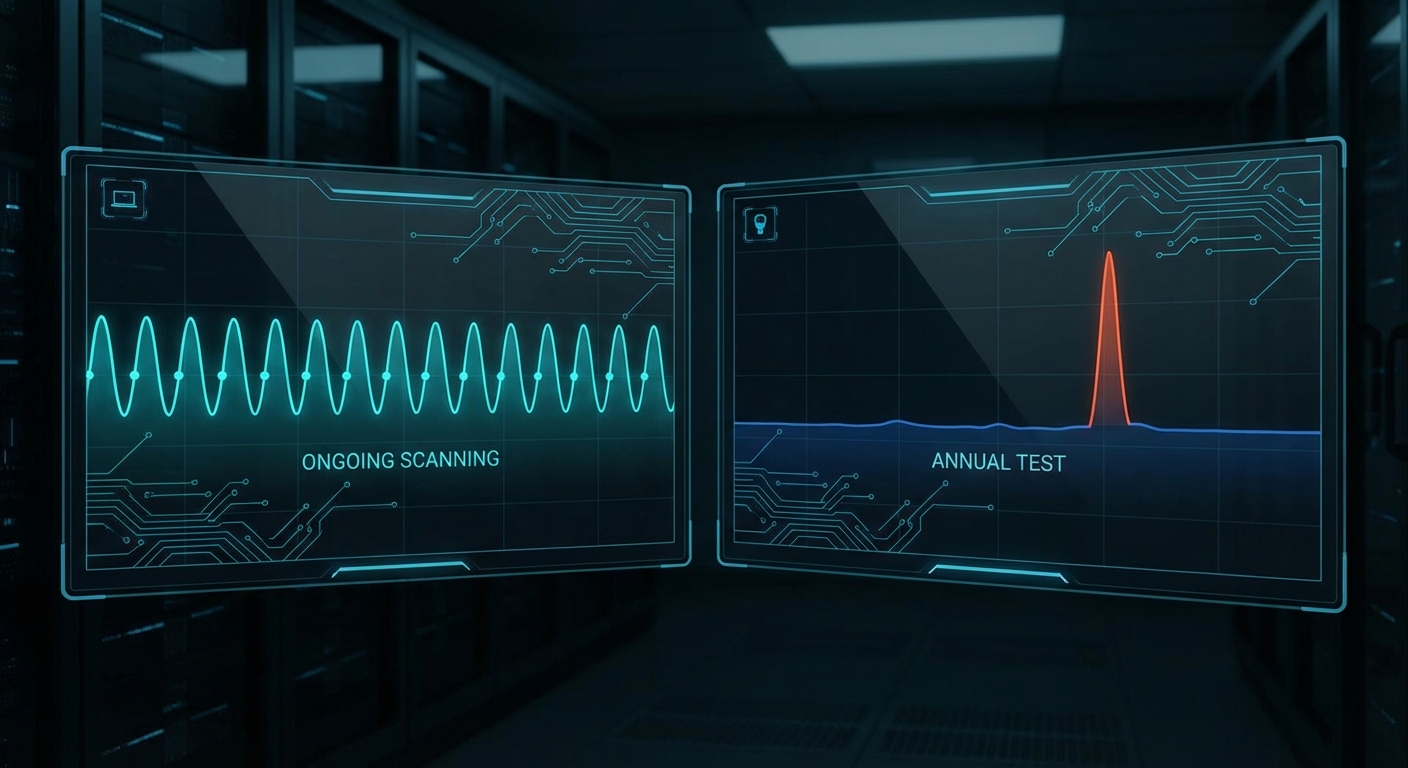
For over a decade, the annual penetration test has been the standard engagement model for security service providers. Once a year, a team of testers spends a week or two probing a client's systems, produces a report, and moves on. The client addresses the findings -- or doesn't -- and the cycle repeats twelve months later. This model is familiar, but it is fundamentally broken.
Why Annual Pentests Are Outdated
Modern software development moves at a pace that makes annual testing irrelevant within weeks of completion. Organizations deploying code weekly -- or daily -- introduce new attack surfaces faster than annual assessments can identify them. A pentest completed in January provides limited assurance about the application's security posture by March, let alone by the following January.
The numbers illustrate the gap clearly. The average enterprise deploys code changes hundreds of times per year. Each deployment can introduce new vulnerabilities: a misconfigured API endpoint, an authentication bypass in a new feature, a dependency update that introduces a known CVE. An annual test captures a snapshot of one moment in time, missing the vast majority of changes that occur throughout the year.
Attackers, meanwhile, do not operate on annual schedules. Automated scanning tools continuously probe internet-facing assets, and newly discovered vulnerabilities are weaponized within days. The window between when a vulnerability is introduced and when it is exploited is shrinking -- often to less than a week for critical issues. An annual test cannot close a window that opens and closes hundreds of times between assessments.
Compliance Is Shifting Toward Continuous
Regulatory frameworks are catching up with this reality. PCI DSS 4.0 introduced requirements for more frequent testing and continuous monitoring. SOC 2 auditors increasingly expect evidence of ongoing security validation rather than point-in-time assessments. Cyber insurance providers are beginning to offer better premiums to organizations that can demonstrate continuous testing programs.
ISO 27001:2022 emphasizes risk-based thinking and continuous improvement, making the case that security testing should be an ongoing process rather than a periodic checkbox. For service providers, this regulatory shift creates both a challenge and an opportunity. Clients who previously bought one pentest per year are now being told by auditors and insurers that they need more. The providers who can deliver continuous testing efficiently will capture this expanding demand.
"Annual pentesting is like getting a physical exam once a year and assuming you are healthy for the other 364 days. Continuous testing is the security equivalent of wearing a fitness tracker -- always monitoring, always alerting."
The Recurring Revenue Opportunity
For security service providers, the shift from annual to continuous testing transforms the business model in a powerful way. Annual pentests are project-based revenue: lumpy, unpredictable, and requiring constant sales effort to maintain the pipeline. Continuous testing, by contrast, is subscription-based revenue: predictable, recurring, and with much higher lifetime client value.
Consider the economics. An annual pentest might generate $15,000 to $25,000 per client per year. A continuous testing program -- monthly or quarterly automated assessments supplemented with periodic deep-dive manual testing -- can generate $3,000 to $8,000 per month, or $36,000 to $96,000 annually. The revenue per client doubles to quadruples, and the delivery cost per assessment drops dramatically because automation handles the bulk of the recurring work.
Client retention also improves significantly. When a client relies on your platform for continuous security monitoring, the switching costs are much higher than with an annual project-based engagement. The client's security team builds workflows around your testing cadence, integrates your reports into their risk management processes, and develops institutional knowledge of your platform. This stickiness reduces churn and creates a defensible revenue base.
Better Security Outcomes
Beyond the business model advantages, continuous testing simply produces better security outcomes. Vulnerabilities are identified within days of introduction rather than months. Remediation can be verified immediately rather than waiting for the next annual cycle. Trends become visible -- is the client's security posture improving or degrading? -- which enables proactive advisory services rather than reactive report delivery.
This creates a virtuous cycle for the partner-client relationship. Continuous testing demonstrably reduces risk, which justifies the ongoing investment. Clients see tangible, measurable improvement in their security posture, which strengthens trust and opens doors to additional service upsells. The partner transitions from being a vendor who shows up once a year to being an embedded security advisor with continuous visibility into the client's environment.
Annual pentests are project-based revenue: lumpy, unpredictable, and requiring constant sales effort. Continuous testing is subscription-based revenue: predictable, recurring, and with 2x to 4x higher lifetime client value. The switching costs for clients also increase dramatically, reducing churn and creating a defensible revenue base.
Making the Transition
The practical barrier to offering continuous testing has historically been cost. Running monthly pentests with traditional manual methods would require four to twelve times the labor, making the economics unworkable for most clients and most providers. AI-powered automation removes this barrier entirely. Automated scans can run weekly or even daily at negligible marginal cost, with human experts focused on validating critical findings and performing targeted deep-dive testing on high-risk areas.
For partners ready to make this transition, the playbook is straightforward: start by offering existing annual clients a continuous monitoring add-on at a modest monthly fee. Demonstrate the value by catching a vulnerability that would have gone undetected until the next annual test. Once clients experience the difference, upgrading them to a full continuous testing program becomes a natural conversation rather than a hard sell.